
Bonuses, terms and complaints without chasing offers
 Available in US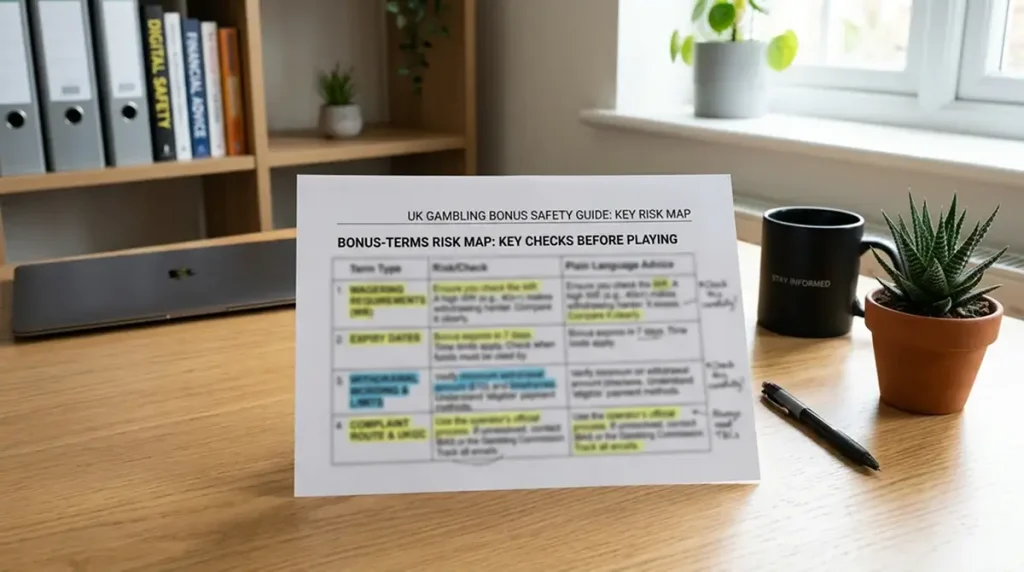
A gambling bonus is not just a headline number. It is a set of conditions that can affect how you use your balance, which games count, when a promotion expires, how winnings are treated, and what happens if there is a dispute. This page is not a list of offers. It is a practical way to read terms before a promotion pushes you into a rushed decision.
Treat the offer as conditions first
Promotion wording can make a gambling site look more attractive than it really is. The safer starting point is to ignore the headline and read the restrictions as if you were already trying to withdraw. Ask whether the offer is easy to understand before money is committed. If you cannot tell what counts, what is excluded, how long the offer lasts, or which balance is affected, the uncertainty belongs in your decision before you deposit, not after a disagreement starts.
Official and consumer-protection materials in Great Britain have repeatedly treated confusing promotions, high wagering requirements and unclear withdrawal restrictions as real problems. That does not mean every promotion is unfair, and it does not allow a reader to decide that a specific term is unlawful without proper evidence. It does mean the terms deserve careful attention. An offer that needs several pages of conditions may still be understandable, but only if the important parts are clear enough for an ordinary customer to follow.
The phrase “casino not on GAMSTOP” can add another layer of risk because the commercial promise may be built around fewer barriers, larger offers or easier access. None of those claims answers the basic question: can you understand what the business will do with your money and what route you have if it goes wrong?
Terms risk map
| Term to check | What to look for | Why it matters |
|---|---|---|
| Wagering requirement | Whether the terms explain how many times a bonus or related winnings must be wagered before withdrawal. | A high or unclear requirement can turn a headline offer into a long and risky obligation. |
| Game and product restrictions | Whether casino games, slots, live games, sports bets or mixed products count differently. | Mixed-product rules can make progress hard to understand and can lead to disputes if the reader assumes everything counts. |
| Expiry date | When the offer, bonus balance or related winnings expire, and whether the clock starts at opt-in, deposit or credit. | Short or unclear timing can make a promotion hard to complete and may pressure gambling for the wrong reason. |
| Maximum conversion or cashout | Whether there is a cap on the amount that can become withdrawable after a bonus. | A cap can mean the headline figure is less valuable than it appears. |
| Deposit balance | Whether your own deposit is separated from promotional money and whether it can be withdrawn. | For Great Britain licensed operators, official guidance says customers must be told they can withdraw their deposit balance at any time, including while a bonus is pending or active, subject to regulatory obligations. |
| Withdrawal conditions | Whether ID, payment ownership, account review or bonus status can delay a withdrawal. | Checks can be legitimate, but vague wording can make it hard to tell what will happen after a win. |
| Complaint route | Whether the operator explains how to complain and where unresolved disputes go. | A clear route matters because chat support is not the same as a formal complaint process. |
Deposit balance is not the same as bonus money
One of the most useful distinctions is between your own deposited money and promotional funds. A site may advertise a bonus as if everything becomes one simple account balance, but the terms may divide money into several categories. The important question is whether your own deposit can be withdrawn and how the site explains that right. In the Great Britain licensed setting, the official position is that customers must be told they can withdraw their deposit balance at any time, including while a bonus is pending or active, subject to regulatory obligations.
That statement should not be stretched into a promise about every site in every jurisdiction. It is a reason to read the wording carefully. If the site does not clearly explain which part of the balance is deposit money, which part is bonus money, and what happens when a promotion is cancelled, the risk is not theoretical. It can become the difference between a normal withdrawal and a dispute over terms you did not understand when depositing.
Also check whether accepting a promotion changes the route for withdrawal. Some terms say the bonus must be forfeited before a deposit balance can be taken out. Others use different balance labels. The safer approach is to write down the rule in your own words. If you cannot do that after reading the terms, the rule is not clear enough for a confident decision.
A complaint path without a promised outcome
If a withdrawal or bonus dispute starts, keep the issue narrow and factual. Save the terms that applied when you accepted the offer, the date of opt-in, the deposit record, any account messages, the withdrawal request and the operator’s response. Avoid arguing from memory where possible. A clear timeline is more useful than a long complaint that mixes several issues together.
- Use the operator’s formal complaint route. A live chat transcript may help, but it may not be the formal complaint process. Look for the complaints page or terms section that explains how to raise a dispute.
- Ask which exact term is being applied. If a bonus restriction is being used to delay or reject a withdrawal, ask the operator to identify the term and explain how it applies to your account history.
- Separate bonus disagreement from identity checks. Verification and source-of-funds questions belong with account checks; bonus interpretation belongs with the promotion terms. Mixing them can make the dispute harder to follow.
- Escalate only through the appropriate route. Official guidance for gambling disputes allows unresolved complaints to move to an Alternative Dispute Resolution provider after the business process and the relevant time boundary, commonly described as eight weeks in the official route.
- Do not assume success. A complaint route gives a process, not a promise that money will be paid. The useful result may be a clearer explanation, a correction, or a decision that the terms were applied as written.
What promotion wording should never decide for you
A promotion should not be used as a way to recover losses, deal with debt, or justify gambling when you already feel under pressure. Advertising rules and responsible marketing guidance put strong boundaries around gambling being presented as a financial solution. If the offer is attractive mainly because you hope it will repair a previous loss, pause before reading more terms. The problem is not the size of the bonus; it is the reason the bonus feels urgent.
It is also sensible to distrust vague reassurance. “Fast payouts”, “easy verification” or “exclusive rewards” do not replace clear terms, official licence checks, customer-funds wording and a complaint route. If a promotion pulls attention away from those checks, treat that as a warning sign. A careful decision is not made by finding the largest number. It is made by understanding what happens if you deposit, accept, cancel, win, lose, withdraw or complain.
If self-exclusion, bank blocks, chasing losses or loss of control are part of the background, move away from promotion checks and use support resources instead. The page on self-exclusion, bank blocks and support is the better next step in that situation.
Where this page stops
This page does not decide whether a particular site is licensed, safe or suitable. For the exact-domain check, use the Gambling Commission register guide. For payment methods, identity checks and withdrawal mechanics, use the payments and verification guide. If the concern is privacy, cookies or a suspicious site, use the privacy and reporting guide.
- Main guide
- Licence and register checks
- Payments, ID and withdrawals
- Self-exclusion and support
- Privacy and reporting checks
